
You do not need a consultant or lawyer to renew a NYC liquor license. The New York State Liquor Authority (SLA) publishes the application, the community board notice form, and the mailing address and the deadline. A renewal is those two forms, a $1,000 bond, a check, and two envelopes: one to your community board, one to the SLA. This guide walks through each part in order, using the SLA's own instructions. If you would rather have the forms filled in for you, the NYC liquor license renewal packet builder reads your advisory and returns both forms ready to sign. If you do not hold a license yet, the free New York liquor license application tool fills the on-premises application from your answers.
If you plan to move, check the public 311 complaint history at the new New York City address before you send a board notice for it.
How often a NYC liquor license comes up for renewal
It depends on what you sell.
| License | Term |
|---|---|
| On-premises wine and liquor | Two years |
| On-premises or off-premises beer | Three years |
| Package store or wine store | Three years |
| Seasonal | Every year |
Most bars and restaurants hold an on-premises liquor license, so most owners renew every two years. The expiration date is printed on your license certificate and on the renewal advisory.
The 90-day timeline
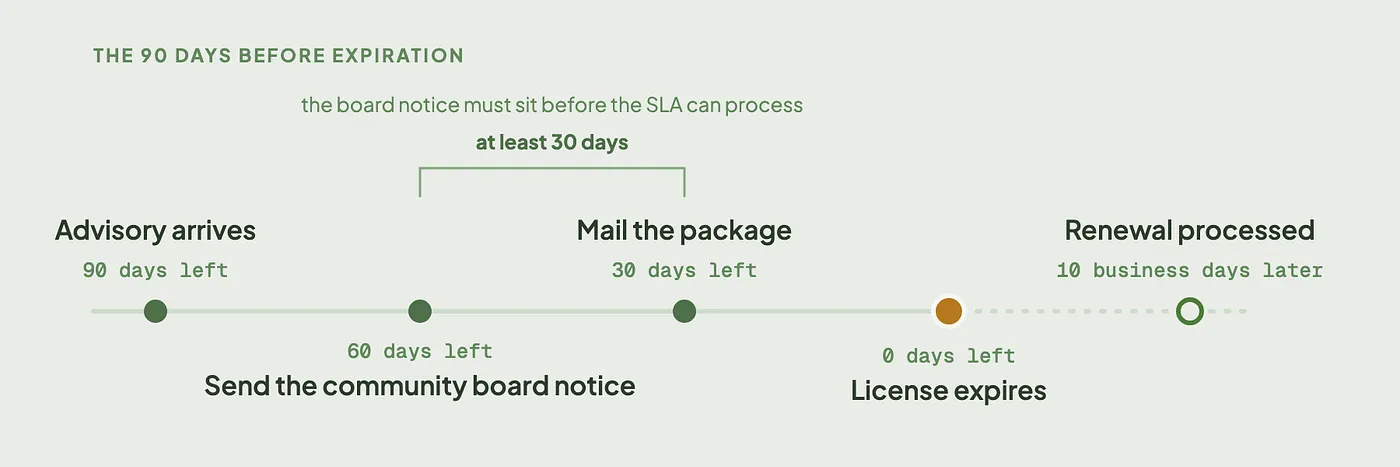
The dates on the timeline leave slack. The SLA's hard limits are 30 days between the board notice and the filing, and a filing at least seven calendar days before expiration.
Step 1: Get your renewal advisory
About three months before your license expires, the SLA mails a renewal advisory to the premises address on file. It lists your license ID, the expiration date, and the total fee due. You need it in two places: the fee goes on your check, and the advisory itself goes in the envelope with the application.
If it never arrived, or someone threw it out with the junk mail, you can find it online. The SLA posts renewal advisory letters by month and license type, and you can search the PDF for your business name and print your page.
Step 2: Notify your community board 30 days before you file
Every on-premises licensee in the five boroughs, whether licensed for beer, wine or liquor, must tell the local community board that it plans to renew. The notice must go out at least 30 days before you file with the SLA. Since the SLA also wants the application at least seven calendar days before expiration, count back from the expiration date: notice out by day 37 at the latest.
Use the SLA's Standardized Notice Form, not a letter. It asks for the license ID and expiration date, the address, what you sell, how much food you serve, your method of operation, any outdoor area, and your landlord's details. Check the Renewal box under the New York City section. A principal signs it under penalty of perjury.
Send it one of four ways, and keep the proof:
- Certified mail, return receipt requested. Keep the receipt or the green card.
- An overnight delivery service. Keep the delivery receipt.
- Personal delivery. Have the board date-stamp a copy.
- Email, but only if your board has said it accepts notices by email. Check the board's website first.
Not sure which board covers your address? The city's Find Your Community Board page looks it up by address. Fernway's packet builder does the same lookup from the premises address on your advisory.
The board cannot approve or deny a renewal. It can send complaints or recommendations to the SLA, and some boards use the notice to ask you to a meeting or to agree to stipulations on hours or noise. Answer if they ask.
Step 3: Fill in the renewal application
The retail renewal application is seven pages. Every section must be completed, and a blank one delays the whole packet. Collect these answers first.
Premises. Whether the premises is closed or the license is in safekeeping. The premises name, license ID, trade name and federal EIN. Your method of operation from a fixed list (restaurant, bar/tavern, hotel, club and so on). Whether employees dance. Any conditions you agreed with the community board or that the SLA placed on the license. Address, county, email and phone.
Landlord. Name and address of the building owner, even if you own the building yourself. Whether you have a lease or other agreement giving you control of the premises.
Arrests and convictions. Whether anyone connected to the license was arrested or convicted during the renewal period, minor traffic violations excepted. If yes, attach the court paperwork.
Principals. Name, date of birth, Social Security number, home address and phones for each principal. A sole proprietor signs alone. Every partner signs. For a corporation or LLC, an authorized officer signs and attests that the company is in good standing with the New York Department of State, then lists every other principal.
Two rules about changes. First, the only change you can make on a renewal is a trade name (DBA) change, and that needs the Department of State's assumed name filing receipt attached. Second, if principals, the physical layout, or the method of operation changed, file the separate change application and get SLA approval. Writing the change into the renewal is not enough and can get the renewal disapproved.
Step 4: Buy the surety bond
Every retail licensee files a $1,000 surety bond at each renewal. It insures payment of any penalty the SLA imposes. Buy it from a surety company approved by the New York Department of Financial Services. Most brokers who insure restaurants can write one within a day.
Three details the SLA checks:
- The licensee signs the bond.
- The bond expires on the same date as the new license expiration shown on your advisory.
- The premises name and address are typed exactly as they appear on your license certificate. Not the trade name, not an abbreviation.
Mail the original, not a copy.
Step 5: Write the check
Make a check or money order payable to New York State Liquor Authority for the total amount printed on the renewal advisory.
Step 6: Assemble the packet and mail it
Put these in one envelope:
- The renewal advisory.
- The completed renewal application, all pages, signed.
- The check or money order.
- The original signed surety bond.
- A copy of the Standardized Notice Form you sent to the community board.
- Proof of delivery: the certified mail receipt or return card, the courier receipt, or the board's date-stamped copy.
- If a trade name changed, the assumed name filing receipt.
Mail everything to:
M&T Bank Lockbox
New York State Liquor Authority
PO Box 8000-Dept 930
Buffalo, New York 14267
Note that is a bank lockbox, not an SLA office. Packets sent to any other SLA address are returned, and the clock keeps running while they come back.
The SLA asks for the application at least seven calendar days before expiration and allows ten business days for processing. A complete packet gets you either a new license certificate for the next period or a letter explaining a denial.
What happens if you file late
If the application is not filed before the license expires, or it is incomplete, you cannot sell alcohol from the expiration date until the SLA renews the license. You also cannot let customers bring their own or give drinks away in that gap.
A late filing is not a dead end. Send the renewal packet as above and add the SLA's Late Renewal Requirements form for retailers. It asks four things: why the renewal is late, whether you bought any alcohol after expiration, whether you received a summons for selling without a license, and whether the premises stayed open. A principal signs it. If the SLA asks for the form after you have already mailed the packet, email it to renewals@sla.ny.gov.
The form warns that a false statement is grounds for disapproval or revocation.
Common mistakes that bounce a renewal
- Sending the notice to the community board fewer than 30 days before filing, or not keeping the proof.
- A bond with the wrong expiration date or a name that does not match the certificate.
- Skipping the landlord section because you own the building.
- Leaving the arrest question blank instead of checking No.
- Using the renewal to report a new partner or a new bar layout.
- Mailing to the SLA's Harlem or Albany office instead of the Buffalo lockbox.
- Filing twice because a representative also filed. The SLA refunds the second check, but not quickly.
A faster way to do the same thing
Everything above is paperwork, and paperwork is what the NYC liquor license renewal packet builder does. Upload the advisory, and it pulls the license ID, expiration date and fee. It finds your community board from the address and fills both forms around it. You sign both electronically, print, and mail two envelopes: one to the board now, one to the Buffalo lockbox 30 days later.
Questions
Do I need a lawyer to renew a NYC liquor license?
No. The SLA publishes the renewal application, the community board notice form, the bond amount and the mailing address. An owner can complete and mail the packet alone. A notice of appearance is only required if an attorney or representative helped.
How early should I start a NYC liquor license renewal?
When the renewal advisory arrives, about three months before expiration. The community board notice must go out at least 30 days before you file, and the SLA wants the application at least seven calendar days before the license expires.
How much is the surety bond for a NYC liquor license renewal?
$1,000 for every retail licensee. The bond must be signed by the licensee, expire on the same date as the new license, and show the premises name and address exactly as printed on the license certificate.
Where do I mail a New York liquor license renewal?
M&T Bank Lockbox, New York State Liquor Authority, PO Box 8000-Dept 930, Buffalo, New York 14267. The SLA returns packets sent to any other address, which delays the renewal.
What happens if I miss my liquor license expiration date in NYC?
You cannot sell, serve or give away alcohol, or allow BYOB, from the expiration date until the SLA renews the license. File the full packet plus the SLA's Late Renewal Requirements form for retailers, which asks why the filing is late and whether the premises kept operating.
This guide is general information, not tax or legal advice. Check the current form and instructions, or ask a tax professional about your own situation.